2025年度の大学入学共通テスト英語第7問の解説をしています。疑問点が残らないよう、解き方の手順も踏まえて一問一問どこよりも丁寧に説明します。
問題
You are preparing a presentation for a science project on animal habits. You found some interesting information in the article below and are now making your outline.
Animal Sleep Patterns
If you ever spend all day at home, you might notice that your pet cat sleeps a lot during the day and is quit active in the evening and early morning. Humans, on the other hand, are awake during most of the daylight and evening hours and then sleep for a long time at night.
Sleep is essential for animals’ physical and mental health, and for their bodies to function efficiently. For animals with brains and central nervous systems, sleep is generally defined as an altered state of consciousness characterized by specific body positions, closed eyes, a general decrease in physical activity, and slower response rates. Sleep also gives the brain neurons a chance to reset, and the body becomes energized. Most creatures experience states of sleep, but the types and patterns differ from species to species.
Different sleep patterns over a 24-hour cycle have been identified in various types of animals. Three common patterns are called monophasic, biphasic, and polyphasic. Monophasic sleep, experienced by humans and many larger animals, happens when one is awake and active for many hours, and then one sleeps for an extended period. Some birds, insects, and mammals utilize a kind of biphasic sleep, where the animal has two waking and sleeping times, with one sleep being long and the other like a nap. Dogs and cats are polyphasic, meaning they have four to six sleeping and waking periods throughout the day.
There are various in sleep patterns depending on the animal’s size, physical needs, and diet. Smaller animals such as squirrels or mice tend to use up their energy by moving quickly and frequently. This results in the need to sleep more often but for shorter periods of time. Lions are carnivorous animals and have longer sleeping because their food sources satisfy their hunger for periods. Large herbivores like wild horses, on the other hand, sleep less than meat-eating animals because their plant-based diet has relatively few calories, resulting in the need to spend most of their time searching for food.
Safety is another variable in sleep patterns. Animals that can create safe spaces tend to enjoy longer periods of sleep, but those that might need to stay alert sleep less. Apes sleep on platforms, high above the jungle floor, which keep them away from attackers. Some smaller animals such as rabbits create shelters by digging into the ground where it is difficult for predators to find them. As a result, they feel safer and sleep longer. In contrast, elephants often travel long distances and may feel exposed to danger from hunters or other animals, contributing to their short sleeping times.
The animal sleep patterns discussed so far tend to be typical. A pattern that may be less easily noticed in our daily lives is called unihemispheric sleep. In this type of sleep, some animals traveling in a group keep one eye open. While on side of the animal’s brain sleeps, the other side stays awake and alert to its surroundings. In this way, the animal can experience the reviving effects of sleep while also watching out for threats. This unihemispheric sleep occurs in some bird species when they are flying long distances in groups. Birds flying at the outer edge of the group use this type of sleep to help protect the other members that sleep with both eyes closed.
Besides the types of sleep explained above, there are patterns that can be considered to be sleep-like activities. Hibernation, which can be observed in black bears, is a long, inactive period when food is scarce or the weather is severe. During this time, the animal’s body temperature drops, its heart rate and breathing slow down, and it may appear dead. Creatures such as jellyfish that have no central nervous system also experience times of extreme relaxation where they remain in a less responsive state.
As shown above, sleep plays an important role in the lives of animals and it is much more complex than simply closing the eyes.
Your presentation outline
How Animals Sleep
Importance of Sleep ( 32 )
A. To alter body temperature
B. To maintain overall health
C. To refresh the animal’s body
D. To reset the brain neurons
Biphasic Sleep Pattern (in each 24-hour cycle)
( 33 )
Some Conditions Affecting Sleep Patterns
– Animals ( 34 ).
– Animals ( 35 ).
Unihemispheric Sleep
– Some birds ( 36 ).
( 37 )
– Black bear hibernation
– Jellyfish relaxation
問1 Under the heading, “Importance of Sleep,” you spotted an error in your presentation outline. Which of the following should you remove?
- A
- B
- C
- D
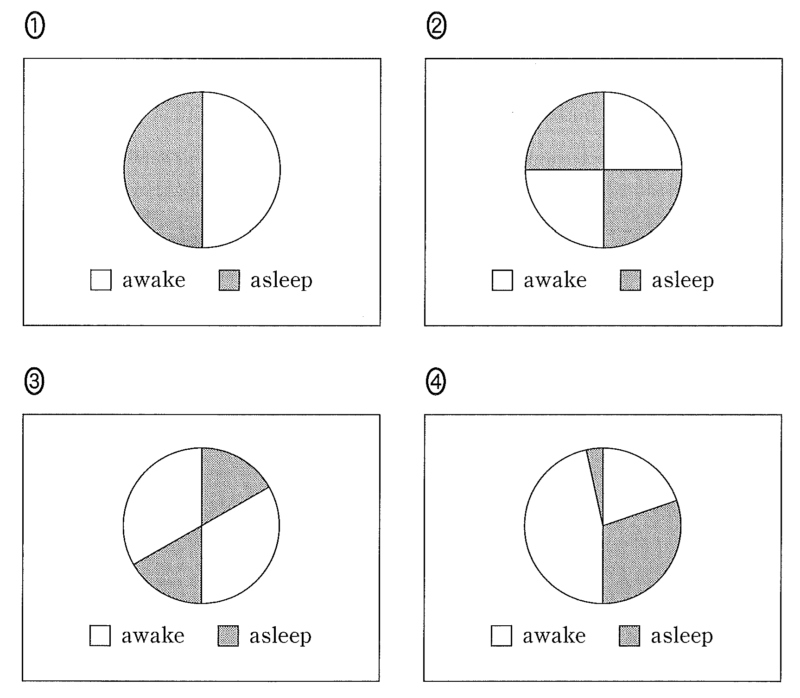
問2 You want to use a figure for the biphasic sleep pattern mentioned in the article. Choose the best option for ( 33 ).
問3 Choose the best options for ( 34 ) and ( 35 ). (The order does not matter.)
- which burn up energy rapidly tend to sleep more often
- which continually search for food need longer sleep
- whose diet has fewer calories can sleep more easily
- whose food keeps their stomachs full usually sleep longer
- whose homes are difficult to get to typically sleep less
問4 Choose the best option for ( 36 ).
- can be partially asleep and partially awake while in fight
- can have half of their brain sleep, leading to increased heart rate
- can keep both eyes open constantly to watch out for enemies
- can protect the outside members from inside the group
問5 Choose the best heading for ( 37 ).
- Common Patterns of Sleep
- Natural Sleep Methods
- Reasons for Sleep
- States Similar to Sleep
解説 問1
Under the heading, “Importance of Sleep,” you spotted an error in your presentation outline. Which of the following should you remove?
プレゼンテーションのアウトラインの中で、「Importance of Sleep」という見出しの下に誤りを見つけました。次のどれを削除する必要がありますか
「Importance of Sleep / 睡眠の重要性」の下にある項目を確認しましょう。
A. To alter body temperature
体温を変える
「body temperature / 体温」について、第七段落にこうあります。
During this time, the animal’s body temperature drops, its heart rate and breathing slow down, and it may appear dead.
この間、動物の体温は低下し、心拍数と呼吸は遅くなり、死んでいるように見えることがあります。
体温が低下すると書いてあります。ですが、これはクマの「冬眠」の話で、「sleep-like activities / 睡眠に似た活動」の話です。また体温が変化するのが良いことだとは、この記事では判断できません。この項目は「睡眠の重要性」としてふさわしくありません。
B. To maintain overall health
全体的な健康を維持する
「health / 健康」について、第二段落にこうあります。
Sleep is essential for animals’ physical and mental health, and for their bodies to function efficiently.
睡眠は動物の心身の健康、そして体が効率的に機能するために不可欠です。
選択肢の「overall health / 全体的な健康」が、本文の「physical and mental health / 心身の健康」に対応しています。この項目は「睡眠の重要性」としてふさわしいです。
C. To refresh the animal’s body
動物の体をリフレッシュする
D. To reset the brain neurons
脳のニューロンをリセットする
「body / 体」と「the brain neurons / 脳のニューロン」について、第二段落にこうあります。
Sleep also gives the brain neurons a chance to reset, and the body becomes energized.
睡眠はまた、脳のニューロンをリセットする機会を与え、体が活性化します。
選択肢の「refresh / リフレッシュする」と本文の「energized / 精力を与える」が対応しており、「脳のニューロンのリセット」についても書かれています。これらの項目は「睡眠の重要性」としてふさわしいです。
つまり削除する必要がある項目は「A」です。ということで、正解は「1」です。
実際には睡眠で体温は下がり、それによって脳が休まるそうです。ただ「体温を下げる」ことが重要ではなく、「脳を休める」ことが重要なのですから、その意味でも「1」は的外れな項目になっていますね。
解説 問2
You want to use a figure for the biphasic sleep pattern mentioned in the article. Choose the best option for ( 33 ).
記事に記載されている biphasic睡眠パターンの図を使用します。( 33 ) に最適な選択肢を選んでください。
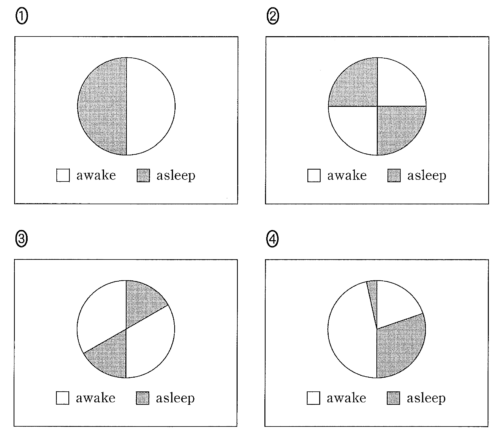
「biphasic sleep」について、第三段落にこうあります。
Some birds, insects, and mammals utilize a kind of biphasic sleep, where the animal has two waking and sleeping times, with one sleep being long and the other like a nap.
一部の鳥、昆虫、哺乳類は biphasic睡眠の一種を利用しています。それは、動物は2回の起床と就寝の時間があり、一方の睡眠は長く、もう一方は昼寝のようなものです
長い睡眠と、昼寝のような短い睡眠があるグラフは「4」です。ということで、正解は「4」です。
人間でも昼寝したくなりますよね。もしかすると、本来は人間も biphasic睡眠だったりして…
解説 問3
Choose the best options for ( 34 ) and ( 35 ).
( 34 )と( 35 )に最適な選択肢を選んでください
( 34 )と( 35 )は Your presentation outline の「Some Conditions Affecting Sleep Patterns / 睡眠パターンに影響を与えるいくつかの状態」の項目にあります。
Some Conditions Affecting Sleep Patterns
睡眠パターンに影響を与えるいくつかの条件
– Animals ( 34 ).
– Animals ( 35 ).
選択肢を確認しましょう。
1. which burn up energy rapidly tend to sleep more often
エネルギーを急速に消費する動物は、より頻繁に眠る傾向がある
「エネルギーを急速に消費する」について、第四段落にこうあります。
Smaller animals such as squirrels or mice tend to use up their energy by moving quickly and frequently. This results in the need to sleep more often but for shorter periods of time.
リスやネズミなどの小型動物は、素早く頻繁に移動することでエネルギーを消費する傾向があります。そのため、睡眠はより頻繁に必要になりますが、睡眠時間は短くなります。
選択肢の「rapidly / 急速に」と本文の「quickly and frequently / 素早く頻繁に」が対応しています。「頻繁な睡眠が必要」と書いてあります。この選択肢が正しいです。
2. which continually search for food need longer sleep
断続的に食べ物を探している動物は、より長い睡眠を必要とする
「断続的に食べ物を探している動物」について、第四段落にこうあります。
Large herbivores like wild horses, on the other hand, sleep less than meat-eating animals because their plant-based diet has relatively few calories, resulting in the need to spend most of their time searching for food.
一方、野生の馬などの大型草食動物は、肉食動物よりも睡眠時間が短いです。というのも植物ベースの食事は比較的カロリーが少ないため、ほとんどの時間を食料探しに費やす必要があるからです。
「断続的に食べ物を探している動物」である大型の草食動物は、睡眠時間が短いと書いてあります。この選択肢は違います。
3. whose diet has fewer calories can sleep more easily
食事のカロリーが少ない動物は、より気楽に眠れる
「気楽に眠れる」について、第五段落にこうあります。
As a result, they feel safer and sleep longer.
その結果、彼らはより安全だと感じ、より長く眠ります。
しかし、この安全を感じて眠る動物は、食事のカロリーが少ないのではなく、「安全な場所を作ることができる動物」です。この選択肢は違います。
4. whose food keeps their stomachs full usually sleep longer
食べ物でお腹が満たされる動物は、ふつうはより長く眠る
「お腹が満たされる」について、第四段落にこうあります。
Lions are carnivorous animals and have longer sleeping because their food sources satisfy their hunger for periods.
ライオンは肉食動物で、食料源が一定期間空腹を満たすため、睡眠時間はより長くなります
空腹が満たされると睡眠時間が長くなると書いてあります。この選択肢が正しいです。
5. whose homes are difficult to get to typically sleep less
住まいに帰るのが難しい動物は、通常より睡眠が短い
第五段落にこうあります。
Animals that can create safe spaces tend to enjoy longer periods of sleep, but those that might need to stay alert sleep less.
安全な場所を作ることができる動物は睡眠時間が長くなる傾向がありますが、警戒を続ける必要がある動物は睡眠時間が短くなります。
この例で出てくる睡眠時間の短い動物は「ゾウ」です。しかしゾウについて、第五段落にこうあります。
In contrast, elephants often travel long distances and may feel exposed to danger from hunters or other animals, contributing to their short sleeping times.
対照的に、ゾウは長距離を移動することが多く、ハンターや他の動物からの危険にさらされていると感じ、睡眠時間が短くなることがあります。
ゾウの睡眠時間が短いのは、住まいに帰るのが難しいからではなく、住まいを持たず、その結果危険を感じているからです。この選択肢は違います。
ということで、正解は「1」と「4」です。
動物園でもライオンはたいてい寝ていて、ウマは起きていますよね。それにはこういう理由があったのですね。
解説 問4
Choose the best option for ( 36 ).
( 36 )に最適な選択肢を選んでください
( 36 )は Your presentation outline の「Unihemispheric Sleep」の項目にあります。
Unihemispheric Sleep
– Some birds ( 36 ).
「Unihemispheric Sleep」の鳥について、当てはまるものを選ぶ問題です。選択肢を確認しましょう。
1. can be partially asleep and partially awake while in fight
戦闘中に部分的に眠ったり、部分的に目覚めたりすることができます
「部分的に眠ったり、部分的に目覚めたり」について、第六段落にこうあります。
While on side of the animal’s brain sleeps, the other side stays awake and alert to its surroundings.
動物の脳の片側が眠っている間、もう片側は起きていて周囲に警戒しています。
「Unihemispheric Sleep」の鳥は、部分的に眠ったり、部分的に目覚めたりできます。この選択肢が正解です。
2. can have half of their brain sleep, leading to increased heart rate
脳の半分が眠っているため、心拍数が上昇します
心拍数の低下については、第七段落に「black bears」の例がありますが、心拍数の増加についての記述は、この記事にはありません。この選択肢は違います。
3. can keep both eyes open constantly to watch out for enemies
敵を警戒するために両目を常に開いたままにすることができます
「目を開ける」について、第六段落にこうあります。
In this type of sleep, some animals traveling in a group keep one eye open.
このタイプの睡眠では、群れで移動する動物の中に片方の目を開けている動物がいます。
「Unihemispheric Sleep」の鳥は片方の目を開けたまま睡眠し、その片方の目で周囲を警戒します。この選択肢は違います。
4. can protect the outside members from inside the group
群れの内側から外側の仲間を守ることができます
「群れの内側・外側」について、第六段落にこうあります。
Birds flying at the outer edge of the group use this type of sleep to help protect the other members that sleep with both eyes closed.
群れの外側を飛ぶ鳥は、両目を閉じて眠る他の仲間を守るために、このタイプの睡眠を使用します。
内側が外側を守るのではなく、外側が内側を守ります。この選択肢は違います。
ということで、正解は「1」です。
「Unihemispheric Sleep」がキーワードなので、第六段落が該当部分だとわかりますね。ところで夜中にトイレに行くとき、両目を開けるのがだるくて片目で行くことがあるのですが、この話を聞くと、この行動も多少は意味があるのかなぁ。
解説 問5
Choose the best heading for ( 37 ).
( 37 )に最適な見出しを選択してください。
( 37 )は「Your presentation outline」の最後にこうあります。
( 37 )
– Black bear hibernation / クロクマの冬眠
– Jellyfish relaxation / クラゲの弛緩状態
「クロクマの冬眠」と「クラゲの弛緩状態」に、共通するものを選ぶ問題です。選択肢を確認しましょう。
1. Common Patterns of Sleep
一般的な睡眠パターン
2. Natural Sleep Methods
自然な睡眠方法
3. Reasons for Sleep
睡眠の理由
4. States Similar to Sleep
睡眠に似た状態
第七段落にこうあります。
Besides the types of sleep explained above, there are patterns that can be considered to be sleep-like activities.
上記で説明した睡眠の種類以外にも、睡眠に似た活動と見なすことができるパターンがあります。
この後に「Black bear hibernation」と「Jellyfish relaxation」の例が紹介されます。つまりこの二つの例は、「sleep-like activities / 睡眠に似た活動」です。
ということで、正解は「4」です。
「hibernation」の意味が難しいですが、クマの「体温が低下し」「心拍数と呼吸が遅くなり」「死んでいるように見える」とくれば、「冬眠」だと推測できますね。すると常識で考えて、「一般的な睡眠パターン」と「自然な睡眠方法」ではないと判断もできます。
コメントをどうぞ