

2026年度の大学入学共通テスト英語第7問の解説をしています。疑問点が残らないよう、解き方の手順も踏まえて一問一問どこよりも丁寧に説明します。

問題
You prepared a presentation with a discussion question for your science class using the following passage.
Mind-Wandering: Lost in Thought
Rodin’s sculpture The Thinker represents a man absorbed in thought. People may wonder if he is thinking about life’s deep questions. Likewise, teachers may wonder what students sitting at their desks are thinking about─are they focusing on their schoolwork, or are they just daydreaming?
It is natural for the mind to switch between periods of focus and periods of rest. Even when we are supposed to be concentrating, we may not be paying attention to the task at hand. Scientists have found that we engage in daydreaming, also known as “mind-wandering,” approximately 50% of the time we awake. While our minds are wandering, we are not thinking about anything special but our brains naturally come up with ideas, images, and emotions. In short, mind-wandering is a shift away thoughts on the current task to other unrelated thoughts.
Our understanding about mind-wandering has grown over time. Past studies argued that mind-wandering was not merely a waste of time but actually quite harmful. Mind-wandering was found to negatively influence our mood, leading to work-related mistakes, traffic accidents, and even mental conditions such as depression. New research, however, shows that mind-wandering also has positive effects which can enrich our lives in various ways.
One such effect is that mind-wandering helps us generate creative ideas. In fact, some of our best ideas become apparent when our mind are wandering. To access these ideas, however, our brains sometimes require a period of time, just like eggs need time to hatch. This is called the “incubation period.” This interval away from the problem is critical because during that time our brains are unconsciously sorting through pieces of information and association them with the problem. This enables us to come up with a fresh solution, which appears when we least expect it, for example, when we are on a walk or taking a shower.
What is really going on in the brain when the mind wanders? Previously, the brain was thought to be in a passive state at this time. However, through neuroimaging research conducted in 2001 in the US, more than dozen regions of the brain were found to be active during mind-wandering. These regions, as a whole, were named the Default Mode Network (DMN). Moreover, according to a study conducted in 2022 by researchers based in Norway and the Netherlands, the DMN was more active when participants were performing a low-effect task compared to a high-effort task.
How can we make use of new discoveries in brain science and increase the number of unique benefits that mind-wandering has to offer? Here are four tips to help expand your mind. First, make time for simple activities such as doing the dishes or taking a warm bath. When involved with these undemanding tasks, our mind is free to wander around. Next, we can just go outside. For example, when we are in a forest, we are able to relax in nature and our mind can more easily spread out in all directions. Another suggestion is to get enough quality sleep each night. This will not only improve our mood, but enable the brain to be more receptive to new ideas. Finally, when we wake up in the morning, we should try to notice any thoughts that occur before we get out of bed. In this half-sleep state, our mind tends to wander and our ideas can flow more freely.
We will not always be able to control all of our thoughts. However, if we are aware of when and how mind-wandering happens, we may be able to take advantage of its seemingly random nature.
Slide drafts
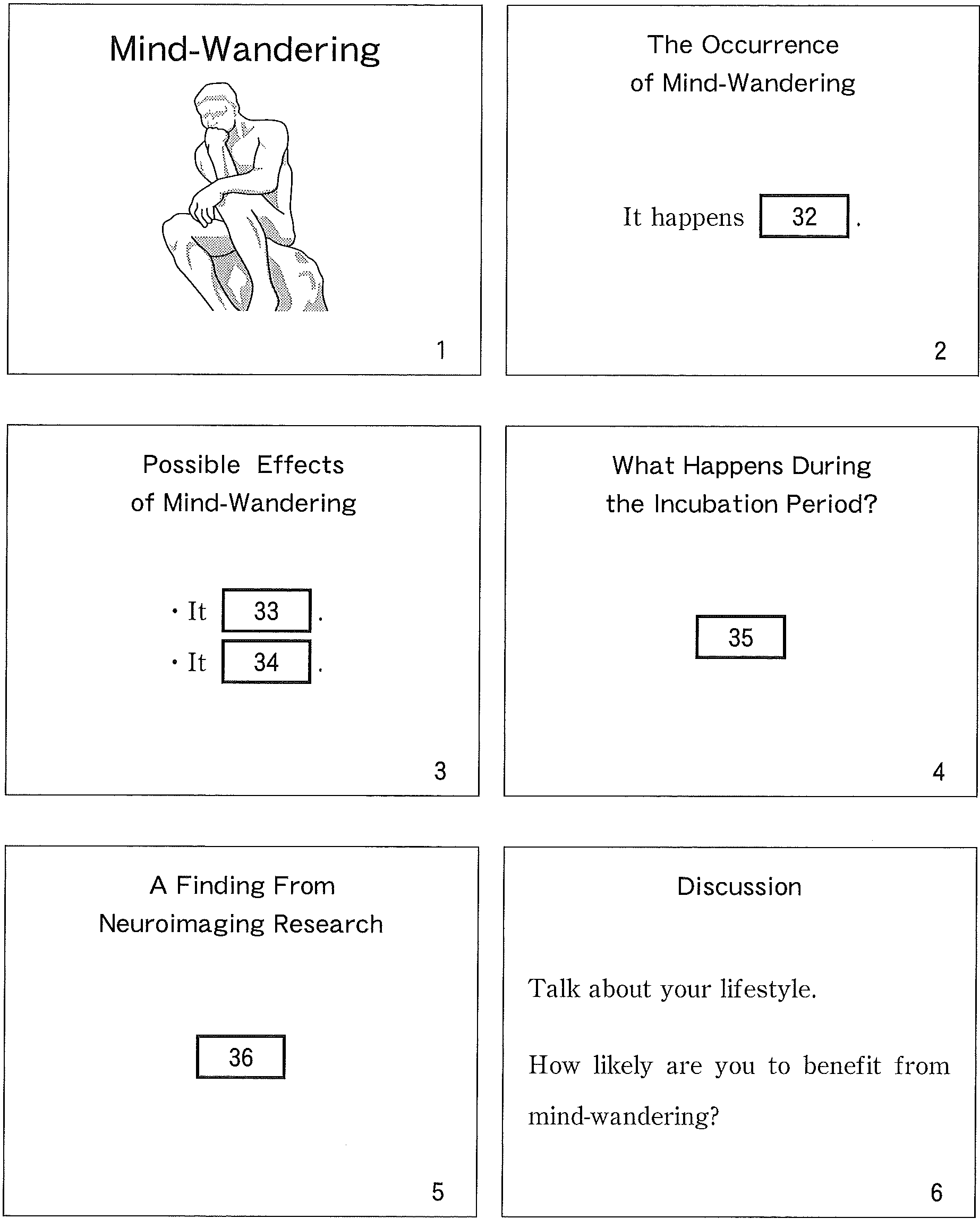
問1 Choose the best option for ( 32 ).
- in about half of the time we are daydreaming
- in the nightmares we experience during sleep
- when our focus is away from the ongoing activity
- while we are concentrating on the present task
問2 Choose the best options for ( 33 ) and ( 34 ).
- affects our mental health
- decreases errors at work
- enhances our memory
- gives us novel ideas
- improves our driving skill
問3 Choose the best option for ( 35 ).
- Complicated problems enter our consciousness.
- Our brains organize information in new ways.
- Our moods are altered from negative to positive.
- The mind moves from an active to a passive state.
問4 Choose the best option for ( 36 ).
- The brain has multiple areas working while the mind is wandering.
- The brain’s DMN is only activated when we perform high-effort tasks.
- The entire brain is inactive when we are working on low-effort tasks.
- The state of the brain remains passive during mind-wandering.
問5 In the discussion session about lifestyles, some students’ habits and routines were shared on the screen. Choose the two students who are most likely to gain the benefits of mind-wandering based on the tips mentioned in the passage.
I’m a book lover. I’ll read anything to expand my mind. I often stay up late to finish another chapter. I drink a lot of green tea to help me stay awake.
-Ami
I like to keep active and do some sort of exercise. I usually go cycling along the riverbank before school. I also like hiking around the countryside on holidays.
-Barry
I’m extremely focused on my schoolwork during the week. So busy! On the weekends I need a break, so I visit my local hot springs to forget about everything.
-Chihiro
I want to be a cooking influencer. I post new recipes to my account almost daily. I check my phone to respond to my followers right after waking up the morning.
-Dean
- Ami and Barry
- Ami and Chihiro
- Ami and Dean
- Barry and Chihiro
- Barry and Dean
- Chihiro and Dean
解説 問1
Choose the best option for ( 32 ).
( 32 )に最も適した選択肢を選びなさい。
( 32 )は Slide drafts の二枚目にあります。
The Occurrence of Mind-Wandering
Mind-Wandering の発生
It happens ( 32 ).
( 32 )に起こります。
Mind-Wandering がどういうときに起こるのかを、選択肢から選ぶ問題です。それを踏まえて、選択肢を確認しましょう。
1. in about half of the time we are daydreaming
夢想している時間の約半分に
第二段落にこうあります。
Scientists have found that we engage in daydreaming, also known as “mind-wandering,” approximately 50% of the time we awake.
科学者たちは、私たちが起きている時間の約50%を夢想、つまり「mind-wandering」に陥っていることを発見しました。
「mind-wandering」は「daydreaming」と同義です。また「mind-wandering」は、起きている時間の50%で起きています。「daydreaming」の50%で起きているのではありません。この選択肢は違います。
2. in the nightmares we experience during sleep
睡眠中に見る悪夢の中で
「daydream」は、起きているときにボーっとすることを表しています。「nightmare / 悪夢」とは関係ありません。この選択肢は違います。
3. when our focus is away from the ongoing activity
進行中の活動から注意が逸れているとき
第二段落にこうあります。
In short, mind-wandering is a shift away thoughts on the current task to other unrelated thoughts.
つまり、mind-wandering とは、現在取り組んでいる課題に関する思考から、無関係な思考へと移ることです。
この選択肢が正解です。
4. while we are concentrating on the present task
現在の作業に集中しているとき
集中していれば「mind-wandering」にはなりません。この選択肢は違います。
ということで、正解は「3」です。

「mind-wandering」とは何なのかが、わかりづらいかもしれません。「wander / さまよう」という意味が示す通り、「心ここにあらず」という、ボーっとした状態のことですね。第一段落に「wonder / 不思議に思う」という似た語が何度も出ているのも、ちょっといやらしいですね。
解説 問2
Choose the best options for ( 33 ) and ( 34 ).
( 33 )と( 34 )について、最も適切な選択肢を選びなさい。
( 33 )と( 34 )は Slide drafts の三枚目にあります。
Possible Effects of Mind-Wandering / Mind-Wandering の考えられる効果
・It ( 33 ).
・It ( 34 ).
Mind-Wandering にはどのような効果があるのかを選ぶ問題です。それを踏まえて、選択肢を確認しましょう。
1. affects our mental health
私たちの精神的健康に影響を与える
第三段落にこうあります。
Mind-wandering was found to negatively influence our mood, leading to work-related mistakes, traffic accidents, and even mental conditions such as depression.
mind-wandering は気分に悪影響を及ぼし、仕事上のミス、交通事故、さらにはうつ病などの精神状態につながることが分かっています。
mind-wandering は「精神状態につながる」とあります。この選択肢が正解です。
2. decreases errors at work
仕事でのミスの減らす
「1」で確認したとおり、mind-wandering は「work-related mistakes / 仕事上のミス」に繋がります。つまりミスは増えるのであって減るのではありません。この選択肢は違います。
3. enhances our memory
私たちの記憶力を高める
第四段落にこうあります。
This interval away from the problem is critical because during that time our brains are unconsciously sorting through pieces of information and association them with the problem.
問題から離れるこの時間は非常に重要です。なぜなら、その間、脳は無意識のうちに情報を整理し、問題と関連付けているからです。
「sorting through pieces of information / 情報を整理し」とあるので、記憶力が高まりそうな気がします。しかしこれは、問題と関連付けるためであって、記憶のためではありません。この選択肢は違います。
4. gives us novel ideas
私たちに新奇なアイデアを与える
第四段落にこうあります。
One such effect is that mind-wandering helps us generate creative ideas.
その効果の一つは、mind-wandering によって創造的なアイデアが生まれることです。
選択肢の「novel ideas」と本文の「creative ideas」が対応しています。この選択肢が正解です。
5. improves our driving skill
私たちの運転技術を向上させる
「1」で確認したとおり、mind-wandering は「traffic accidents / 事故」に繋がります。運転技術は向上しません。この選択肢は違います。
ということで、正解は「1」と「4」です。
過去の研究が否定されているのではなく、過去の研究の成果に新たな研究の成果が加わったのです。mind-wandering には、良い面と悪い面があるんですね。どうしても良い面に目が行きがちですが、悪い面からも選ぶのがポイントでした。スライドのタイトルに「Possible Effects」とあり、本文に「positive effects」とあるのもひっかけポイントでしょうか。
解説 問3
Choose the best option for ( 35 ).
( 35 )に最も適した選択肢を選びなさい。
( 35 )は Slide drafts の四枚目にあります。
What Happens During the Incubation Period?
Incubation Period の間に何が起こりますか
( 35 )
Incubation Period とは何なのでしょうか。第四段落にこうあります。
To access these ideas, however, our brains sometimes require a period of time, just like eggs need time to hatch. This is called the “incubation period.”
しかし、これらのアイデアにアクセスするには、卵が孵化するのに時間が必要なように、脳が一定の時間を必要とすることがあります。これは「incubation period」と呼ばれます。
これを踏まえて、選択肢を確認しましょう。
1. Complicated problems enter our consciousness.
複雑な問題が私たちの意識に入ってきます。
第四段落にこうあります。
This interval away from the problem is critical
問題から離れるこの時間は非常に重要です。
「incubation period」は、問題から離れている時間です。この選択肢は違います。
2. Our brains organize information in new ways.
私たちの脳は新しい方法で情報を整理します。
第四段落にこうあります。
This interval away from the problem is critical because during that time our brains are unconsciously sorting through pieces of information and association them with the problem.
問題から離れるこの時間は非常に重要です。なぜなら、その間、脳は無意識のうちに情報を整理し、問題と関連付けているからです。
選択肢の「organize information」と本文の「sorting through pieces of information」が対応しています。この選択肢が正解です。
3. Our moods are altered from negative to positive.
私たちの気分はネガティブからポジティブに変わります。
「mood」について、第六段落にこうあります。
This will not only improve our mood, but enable the brain to be more receptive to new ideas.
これは気分を良くするだけでなく、脳が新しいアイデアをより受け入れやすくします。
質の良い睡眠をとると気分が良くなるとは言っています。ただそれはネガティブからポジティブに変わるという話ではありません。この選択肢は違います。
4. The mind moves from an active to a passive state.
心は活動的な状態から受動的な状態に移行します。
「a passive state」について、第五段落にこうあります。
Previously, the brain was thought to be in a passive state at this time. However, through neuroimaging research conducted in 2001 in the US, more than dozen regions of the brain were found to be active during mind-wandering.
これまで、この時間帯の脳は受動的な状態にあると考えられていました。しかし、2001年に米国で行われた神経画像処理研究により、mind-wandering の間に脳の12以上の領域が活性化していることが明らかになりました。
これは「a passive state」と思っていたら、実は「active」だったという話です。「active」→「passive」という話ではありません。この選択肢は違います。
ということで、正解は「2」です。
スライドの「Incubation Period」に注目すれば、第四段落が該当部分だと想定できそうです。専門的な話になので、少し難しいかもしれません。「そんなことは言っていないなぁ」という感じで消去法で絞っていくのが実践的だと思います。
解説 問4
Choose the best option for ( 36 ).
( 36 )に最も適した選択肢を選びなさい。
( 36 )は Slide drafts の五枚目にあります。
A Finding From Neuroimaging Research
神経画像処理研究からの結論
( 36 )
「neuroimaging research」は第五段落にでてきます。それを踏まえて、選択肢を確認しましょう。
1. The brain has multiple areas working while the mind is wandering.
mind-wandering の間、脳には複数の領域が働いています。
第五段落にこうあります。
However, through neuroimaging research conducted in 2001 in the US, more than dozen regions of the brain were found to be active during mind-wandering.
しかし、2001年に米国で行われた神経画像処理研究により、mind-wandering の間に脳の12以上の領域が活性化していると導かれました。
選択肢の「multiple areas」と本文の「more than dozen regions」が対応しています。この選択肢が正解です。
2. The brain’s DMN is only activated when we perform high-effort tasks.
脳のDMNは、高負荷のタスクを実行しているときのみ活性化されます。
第五段落にこうあります。
Moreover, according to a study conducted in 2022 by researchers based in Norway and the Netherlands, the DMN was more active when participants were performing a low-effect task compared to a high-effort task.
さらに、2022年にノルウェーとオランダの研究者によって行われた研究では、参加者が高負荷のタスクよりも低負荷のタスクを行っているときに、DMNがより活発に活動することが示されました。
「high-effort task」よりも「low-effect task 」の方が、DMNがより活発に活動します。この選択肢は違います。
3. The entire brain is inactive when we are working on low-effort tasks.
低負荷のタスクに取り組んでいるときは、脳全体が不活性です。
「2」で確認したとおり、「low-effect task 」の方が、DMNがより活発に活動します。この選択肢は違います。
4. The state of the brain remains passive during mind-wandering.
mind-wandering の間、脳は受動的な状態のままです。
第五段落にこうあります。
Previously, the brain was thought to be in a passive state at this time.
これまで、この時間帯の脳は受動的な状態にあると考えられていました。
これまでは「passive」と考えられていました。しかし「1」で確認したとおり、2001年の研究では「active」であるとわかりました。この選択肢は違います。
ということで、正解は「1」です。
「neuroimaging research」は第五段落にでてきます。第五段落を読み終わったら、この設問に取り組むのがよさそうです。「2」と「3」はコインの裏表のように同じ事象を言っています。それに気づければ、両方とも消すことができますね。
解説 問5
In the discussion session about lifestyles, some students’ habits and routines were shared on the screen. Choose the two students who are most likely to gain the benefits of mind-wandering based on the tips mentioned in the passage.
ライフスタイルに関する討論会では、何人かの生徒の習慣や日課がスクリーン上で共有されました。文章に記載されている情報に基づいて、mind-wandering の恩恵を最も得ていると思われる生徒を2人選びましょう。
Ami についてはこうあります。
I’m a book lover. I’ll read anything to expand my mind. I often stay up late to finish another chapter. I drink a lot of green tea to help me stay awake.
私は本が大好きです。視野を広げるためなら何でも読みます。次の章を読み終えるために夜更かしすることもよくあります。眠気を覚ますために、緑茶をたくさん飲みます。
第六段落にこうあります。
Another suggestion is to get enough quality sleep each night.
もう一つの提案は、毎晩十分な質の良い睡眠をとることです。
Ami は夜更かしをしていますので、mind-wandering の恩恵を得られていません。
Barry についてはこうあります。
I like to keep active and do some sort of exercise. I usually go cycling along the riverbank before school. I also like hiking around the countryside on holidays.
私はアクティブに過ごし、何らかの運動をするのが好きです。学校の前には川岸をサイクリングすることが多いです。休日には田舎をハイキングするのも好きです。
第六段落にこうあります。
Next, we can just go outside. For example, when we are in a forest, we are able to relax in nature and our mind can more easily spread out in all directions.
次に、外に出てみましょう。例えば、森の中では自然の中でリラックスでき、心をあらゆる方向に広げやすくなります
Barry は外に出て自然の中にいますので、mind-wandering の恩恵を得られています。
Chihiro についてはこうあります。
I’m extremely focused on my schoolwork during the week. So busy! On the weekends I need a break, so I visit my local hot springs to forget about everything.
平日は勉強に非常に集中しています。とても忙しいですね! 週末は息抜きが必要なので、地元の温泉に行ってすべてを忘れます。
第六段落にこうあります。
First, make time for simple activities such as doing the dishes or taking a warm bath.
まず、皿洗いや温かいお風呂に入るなど、シンプルな活動に時間を割いてみましょう。
Chihiro は温かいお風呂に入っていますので、mind-wandering の恩恵を得られています。
Dean についてはこうあります。
I want to be a cooking influencer. I post new recipes to my account almost daily. I check my phone to respond to my followers right after waking up the morning.
私は料理インフルエンサーになりたいと思っています。ほぼ毎日、新しいレシピをアカウントに投稿しています。朝起きたらすぐにスマホをチェックして、フォロワーに返信しています。
第六段落にこうあります。
Finally, when we wake up in the morning, we should try to notice any thoughts that occur before we get out of bed.
最後に、朝起きたら、ベッドから出る前に浮かんだ考えに気づくようにしましょう。
Dean は起きたらすぐスマホをチェックしていますので、mind-wandering の恩恵を得られていません。
つまりmind-wandering の恩恵を得られているのは「Barry」と「Chihiro」です。ということで、正解は「4」です。
第六段落に「Here are four tips / 四つの情報があります」とあり、その四つの「tips」がそれぞれヒントになっています。全体の印象ではボーっとしているときに mind-wandering が起きるイメージだったので、「Barry」は選びづらかったですが、「tips」と合わせて考えると、ちゃんと選べるようになっていますね。もちろん消去法で選ぶのもいいでしょう。
コメントをどうぞ